No, not in the biblical sense (or in the bedroom sense… boy, I should really rethink that title…)
(This is actually a journal entry, but it felt like a blog post when I finished, so I copied it here too)
I’m almost 50. Well, recently 49, and 49 is close to 50. And while I’ve been financially poor and financially well off, very rarely in my life has the thing I love doing been the same as the thing that makes money. Making money doesn’t really motivate me.
Don’t get me wrong, I WISH IT DID. Because making money, or more specifically *not* making money, is the thing I think about the most. Literally all day every day. For someone not motivated by making money, I think about making money to an absurd degree. And it ends up being a really weird dynamic. Allow me to elucidate a bit. (I mean, this is my journal so whatever I want to blabber about is fine)
I don’t think a person must love their job, and find passion in how they make money in order to be fulfilled in life. In many ways, I think tying your passion to your employment is a dangerous game that often leads to hating the thing you once loved. The nuance for me is, the main thing I’m good at (using technology) is a skill that facilitates the thing which brings me joy (helping other people, improving the lives of other people).
You’d think that would be the dog’s balls. (is that a saying?) I could help people at home, in their businesses, etc. — and it would also be a way to bring in a steady income. But my lack of being motivated by money screws it all up. See, if I help someone and then take money for the help, it no longer feels like I’ve helped them. It becomes a transaction, and all the joy I would get from improving that person’s situation is GONE.
And it’s not because the person feels less helped, or values the assistance any less. In fact, most people find joy themselves in paying for someone’s time when that person really helped them. But for my stupid brain, if it becomes a transaction, the entire mental situation changes. No longer am I helping them, rather it feels like I’m taking advantage of the person because I have a skill they themselves don’t have.
I think that’s part of the reason I love teaching so much. I’d rather everyone be able to help themselves and others than to have the knowledge and ability myself, and then take money for doing the thing. It’s really illogical on my part, and intellectually I *know* it’s illogical, but that doesn’t change how it works in my head.
So back to creation. I love creating things that bring people joy. Be it my comic, or my training, or my writing… heck even this journal entry might entertain someone in a way that makes their day a bit better because, “at least I’m not as messed up as that guy!”
I love creating so much that if I were paid hourly for “creating whatever”, so I could just make stuff all day, there might be concerns over unfair labor practices I’d be committing on myself. BUT, I don’t create that much. And it’s for a really messed up reason:
It doesn’t bring in money.
See, providing for my family is my utmost concern. Maybe that’s unhealthy, but I certainly don’t apologize for it. And due to reasons both good and bad, in order to pay for the things required to live comfortably, I need to make a significant amount of money. The best way I know to make money is currently to work for a company that pays me well for creating IT training content for them. It’s really hard work, and since I don’t know the subject matter beforehand, it means it’s mentally exhausting learning and then immediately teaching from the standpoint of an expert.
That job happens to be quite flexible when it comes to what hours I work though. Awesome, right? Well… The thing is, the more work I do, the more money I can make. So any time I’m doing something NOT directly related to working my DayJob, I have incredible guilt because I’m not making money. So the things I do that bring me joy do NOT bring me joy, because I’m not making any money while I do them. And the screwed up thing is, making money from the things I love to do is not what makes me love them, AND making money from the things I love often (not always) ruins the whole thing for me anyway.
So what’s a weirdo to do?
Well, I have done many things over the years. Recent years have seen me doing things like opening the ability for Patreon support. Also YouTube subscriptions. And KoFi memberships. And recently, Twitch subscriptions. And I made a book of my comic in order to sell a book for money.
Those types of money-making endeavors somehow “hack” my brain a bit, and allow me to experience the joy of creating without it being ruined by selling it. I think it only works because the money isn’t tied to the product, but rather to supporting me as a person. Since the individual “things” aren’t being sold (the comics in the book are all available for free online), the financial compensation is sorta separated from the products of my passions.
The thing is, it doesn’t really feel sustainable. My hope before I had to go back to creating content as my DayJob was that I could maybe grow my YouTube channel enough that I’d get a living wage from ad revenue on YouTube, and I could spend all day every day doing what I love without ruining it by attaching it to money. I haven’t uploaded a single video to YouTube in close to a year, and I still make about $300/mo from ad revenue. So if I put in another couple years, I really might be able to grow to a point that it could become a career.
But also, I don’t want YouTube to be my career… I would love for YouTube (or Patreon, or Twitch, or book sales) to provide me with a steady income that would allow me to separate the things I create from how I pay my mortgage. And if my YouTube channel grew enough that I could “create” full time, would I have the same unhealthy connection with YouTube training that I have with my DayJob now, and always feel guilty if I weren’t making more content for the thing that makes the money?
I think this is why creative folks usually do better when in a group. I don’t think my broken relationship with money is unique to me. (Well, maybe my specific brand of neuroticism is unique, but, “starving artist” is a trope for a reason)
I think the concept that Patreon was built from is fascinating. Traditionally, a patron would be a rich person who paid an artist to do art. I think my brain would require some sort of guaranteed contract in order to really go “all in” on being a creator. But I very often wonder what my life and my day to day activities would look like if I didn’t have to worry about making money. Would I be free to create content and joy? Or would I worry about something else and never really get to squeeze the juice out of life?
Lots of people want to win the lottery so they can retire and do nothing. I’d like to win a small lottery, like a few million dollars, and put the winnings into an index fund. Every month or year (I don’t know how such things work), I could take out a decent salary for myself, confident that salary would be self-sustaining so I could spend all day working. All. Day. Long.
Sometimes that work would be making training videos. Sometimes it would be doing IT work for local businesses in town. Sometimes it would be fishing while I think about stuff. Sometimes it would be writing a book.
And maybe those things would make a ton of money. But they wouldn’t have to. And I think I’d enjoy that work more than anything I’ve ever done. So if you know anyone with a few extra million dollars who wants to run a social experiment with a weird creative guy who has an unhealthy relationship with money, just let me know. 🙂
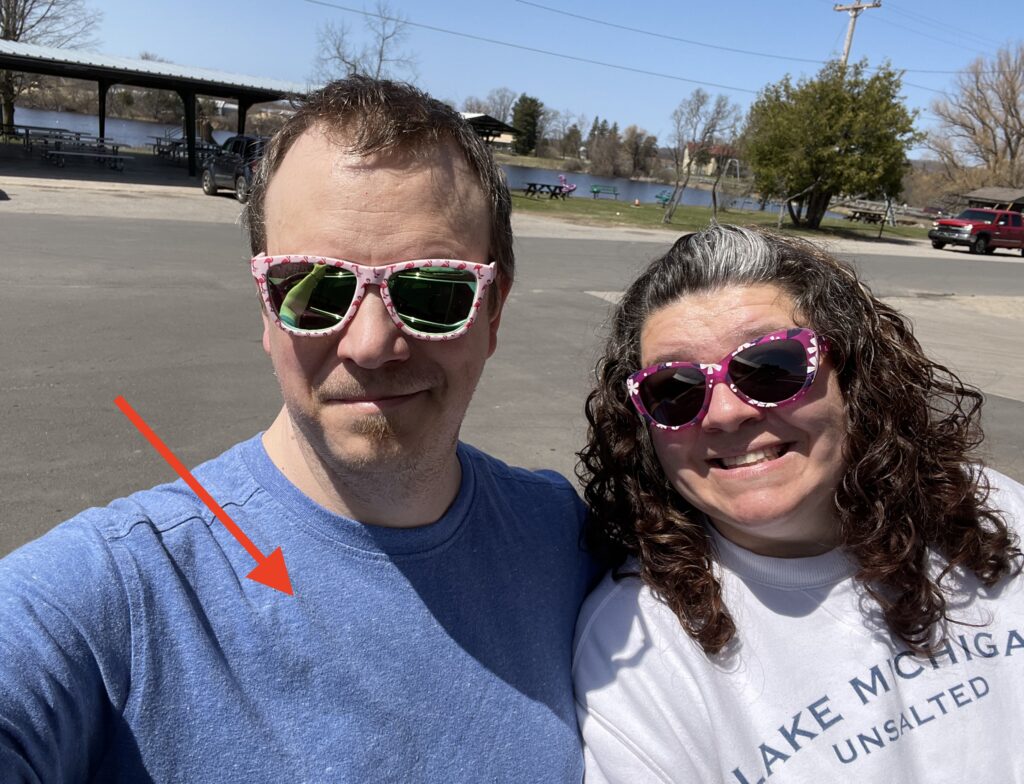
That’s not really true. I have somewhere around 16 shirts. They’re just all exactly the same brand, size, style, and material. I have the same shirt in multiple colors. But they all feel the same. They are a tri-blend fabric, no tags, and extremely soft.
I wear the same thing every day. Since the shirts are different colors, it doesn’t seem like it. I think.
I also usually wear the same type of blue jeans, but I haven’t found my favorite yet, so I have a couple with which I go back and forth.
Someday I might switch to a single color shirt, and a single style pants. One less thing to think about is really, really nice.
It annoys me how prevalent ADHD is in every aspect of my psyche. Really. I’d like to have some qualities and faults which don’t fall directly in line with how ADHD brains work. I used to think I was a special, albeit broken, snowflake. (Not in the political sense, I just mean in the special and unique sense) But nope, even thinking you’re different than everyone else is a symptom of ADHD. If I think about the things that make me uniquely me, it’s ADHD every single time. It seems like the only uncommon thing about me is that ADHD medicine doesn’t work super well to relieve my symptoms. But everything else?
Procrastination: ADHD Self loathing: ADHD Unreliable: ADHD SUPER reliable in an emergency: ADHD Above average pattern recognition: ADHD Superb problem-solving skills: ADHD Self-deprecating humor: ADHD Moody: ADHD Hyperfocus: ADHD Outside the box thinking: ADHD Extreme good looks: ADHD Sarcasm about physical appearance: ADHD
OK, the last couple were jokes. But even that, being funny — a pretty common ADHDer trait. One of the biggest trends with folks who have ADHD is that they only stick with a subject while it’s interesting. Once it gets boring, they can’t (like, actually can’t) focus on it. This is why most folks with ADHD will burn through hobbies and jobs like crazy. I’m no exception here either. But there are a few long-standing passions in my life, and I’ve been trying to figure out why they exist.
Off the top of my head, there are things like Linux, bird feeders/cameras, technology in general, writing, and my wife/family. I know, family doesn’t seem like it qualifies as a “hobby”, but folks with ADHD often have real struggles with romantic relationships. They fall deeply in love (extreme emotions: Another ADHD thing), but once the novelty of the relationship wears off, they lose interest. That hasn’t happened to me. Plus the other things listed have been a sort of staple in my life while so many other hobbies and interests have come and gone. And I’ve been trying to figure out why.
Perhaps it’s because those things are all fairly dynamic and ever changing. Linux is really just a vehicle for all the various software-related hobbies I’ve had over the years. I’ve upgraded and changed the bird feeder cameras dozens of times over the years. Technology is constantly changing. And writing is different every time. Family though? Relationships aren’t easy by any means, but they’re not exactly brand new every day. That “success” doesn’t really fit the same mold as the others.
Maybe it’s not the constant change at all. Maybe it’s the challenge. Relationships are certainly challenging. Attracting birds and getting good video of them is difficult. Writing well is hard. But Linux and technology? I don’t mean to sound arrogant, but no, they’re not difficult or challenging anymore. Yet I still remain interested.
I’d like to have a great answer to finish off this post. Some kernel of wisdom, which peels back the mysteries of the universe just a bit. Heck, even a hint so I might leverage some sort of brain hack to stay excited about the things I SHOULD be focusing on. But no. I have no idea.
I’ve lost interest in this blog post. See you later.
(hehehehe, ok, that was just my attempt at a clever closing)
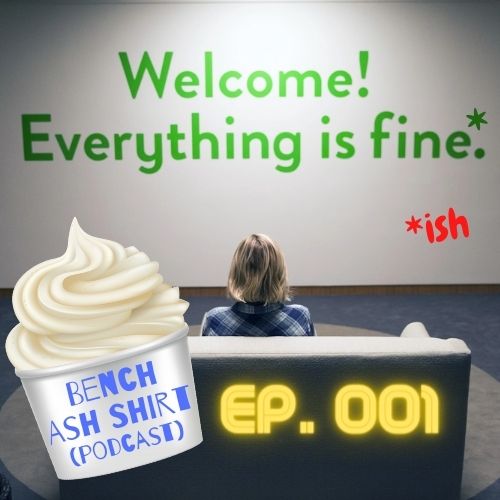
For a while, I was doing a podcast with a group of friends, where every week we’d take turns “deep diving” on a topic we found interesting. The Bench Ash Shirt podcast sorta died off as our lives got busy in different ways, but probably my favorite episode never happened. Or it did happen, but someone forgot to press record. And that someone was me. The episode being about ADHD, and the ADHD guy forgetting to press record was just so on the nose, it hurts.
Ahh, the Bench Ash Shirt podcast… I miss it…
ANYWAY, while I don’t have a recording of the episode, I do have my notes. I was talking to friend recently diagnosed with ADHD (hi Jake!), and on a whim looked for the notes I prepared for that particular deep dive. Usually my notes are terrible, with disjointed thoughts and single word triggers to remind me about a particular thing. For some reason, the notes I made for this episode are pretty elaborate. Even readable, for the most part. Anyway, I figured I’d share them here for anyone wanting to know more about ADHD, from someone who was diagnosed late in life.
SHAWN’S NOTES:
ADHD Podcast Deep Dive
First: ADD & ADHD
It’s all ADHD now, ADD is an old term for “non-attentive” version vs “hyperactive” version.
That’s a spectrum between the two though, and is largely just how a person’s personality responds to the underlying issues.
So ADD is an outdated term, but you still hear it a lot – and I don’t correct people unless they are snotty and all “AKCTUALLY I have ADD, not ADHD”
Brain Chemicals
Endorphins
Runner’s high
Allows us to push ourselves beyond normal limits
Released in response to pain
Why we enjoy laughing so hard it hurts our bellies
Dark Side: self-cutting releases endorphins
Labor pains release lots of endorphins, but also:
Oxytocin
It’s why love, friendship feels good
Behind the feelings of trust, security
This is why we are social creatures – the oxytocin is our reward for caring for and being cared about by others.
That feeling you get from a long hug (consentual) – that’s a release of oxytocin
Dark Side: staying in a bad relationship chasing the love and security, ie, oxytocin
Serotonin
Feeling of pride in what you do, what gives you a sense of being successful
Serotonin is released when a leader leads well
ALSO released when a follower impresses their leader. It’s why we strive to do well for others, regardless if we’re in a follower or leader role.
Self-worth is largely a serotonin-based metric
Dark Side: possibly narcissism (if you think you’re a great leader when you’re not really great)
DEPRESSION is largely a lack of serotonin in the system, or the brain not regulating it correctly. No matter what the reality is, lack of serotonin leaves you feeling worthless with no way to make it better, because doing the “right stuff” doesn’t give you the proper feelings
SSRI – Selective Serotonin Reuptake Inhibitor. The brain vacuum that cleans up excess serotonin is possibly working overtime.
Dopamine
That quick hit of joy from checking off an item on a list
Very short lived. Serotonin drugs take weeks to start working, because that is a slow release slow cleanup system. Dopamine is a quick hit.
Dopamine is addictive. It’s what video games, social media, and cocaine manipulate
Without dopamine, we’d never reach our goals – it’s the reason we take the steps toward larger goals. Without dopamine, there is no motivation to DO anything.
It seems like the least important brain chemical, because it is manipulated for evil all the time, candy crush, etc.
But ADHD is a dopamine issue. And because it’s tied to dopamine, that is why people often think ADHD isn’t really a big thing, or that everyone is ADHD, or when they hear the symptoms of ADHD, they identify with them because they’ve experienced the same things due to technology, etc.
And while there is a serious conversation that can be had with regard to society manipulating dopamine, ADHD isn’t just someone who is more susceptible to dopamine manipulation – their actual dopamine system is broken from the word go:
That little “win” you receive from checking off an item on your to do list is a tiny hit of dopamine. ADHD brains either:
Don’t release that hit
Release far less of it
Clean up the dopamine before its effects are felt
Mind you, dopamine is how you know what to do. Your brain rewards you for doing things that are productive and work toward a larger goal. It’s the most basic of the chemicals we talked about.
Eating releases dopamine, this kept us alive
Sex releases dopamine, this kept us populated
EVERYTHING we do is dictated by our brains leading us around with dopamine carrots
So, without that regulation, the ADHD mind is constantly switching from thought to thought, trying to figure out what it’s supposed to do. This is not a conscious “figure out” – it just knows that dopamine means it’s doing good. So it’s easily distracted, every (literally every) think being a potential source of dopamine, and thus guidance.
The hyperactivity is often physical in children (moreso in boys, thanks to society expecting boys to be boys). And since that physical hyperactivity tends to fade during the transition into adulthood, for many years it was assumed ADHD was merely a childhood affliction. BUT, the hyperactivity doesn’t go away, it just internalizes into racing, unmanageable thoughts. (Still manifests physically some, leg-shakers, etc)
AND, because not all hyperactivity (seeking dopamine guidance) is physical in children, it often goes underdiagnosed. Especially in girls.
AND, if a child is intellectually gifted, they either:
Meet the standards for normal, so aren’t seen as needing diagnosis or treatment (although they’re likely performing WAY below where they could – these children are the ones who, “had such potential”)
Internalize their hyperactivity in the same way adults generally do (perhaps due to introversion, societal expectations, etc), and so their struggles aren’t suspected to be ADHD related because they’re not hyper.
Girls are often “dreamers” instead of seen as needing help.
Boys, well, boys end up never living up to expectations and dyeing their hair green, not to put too fine a point on it.
WHAT ABOUT STIMULANTS?!?
You’ll likely hear that stimulants do the opposite for ADHDers. And on the surface that seems to be true. But that’s not really what’s happening. Now that you have a pseudo-understanding of what’s going on in the ADHD brain, let’s talk about stimulants. (Which are THE most effective psychoactive treatment drugs for their use case across all of psychology. The degree to which they work is off the charts effective.)
Touched on it briefly but dopamine is released by the brain when we do something we’re supposed to do, it binds to neuroreceptors giving us the win, and is then reabsorbed. It’s very short lived, but that’s how the process basically goes.
ADHD brains do one of two things, and sometimes both:
release less (often MUCH less) dopamine when something is accomplished
clean up that dopamine quicker than a typical brain
There are (2) classes of stimulants used to treat ADHD. Amphetamines and Methylphenidate. (Adderall and Ritalin, respectively)
Adderall increases the amount of dopamine released
Ritalin slows down the reuptake of the dopamine
This is why some people respond better to one class of stimulants over the other. Some people have over active brain vacuums, some people have normal vacuums but don’t release the proper amount in the first place. Some have crappy boths.
SO, either way, the stimulants increase the amount of “tonic dopamine” in the brain. How much is sitting around to assure the brain that it’s doing the right thing. So the brain calms TF down, reducing hyperactivity both mentally and physically.
The reason stimulants aren’t a good idea for people with high blood pressure is because the two classes of stimulants also cause the brain to release more norepinephrine. It’s related to epinephrine (Adrenaline) but works more on keeping blood pressure up so the brain is flushed with blood during high stress. (This seems to be less of an issue with standard doses, but more on that later when we talk about abuse)
Here’s the rub though: It calms down the frantic dopamine seeking so an ADHDer can function. BUT increased tonic dopamine just means there’s less jumping from topic to topic (or chair to chair) – it doesn’t FIX how dopamine works to REGULATE daily activities. So medicine is invaluable and even vital for success, but it’s not enough. Once medicated properly, a person with ADHD has to learn to use tools like reminders, lists, schedules, etc., because while they’re not in panic mode – they still don’t get direction from their brains on what to do. A medicated ADHDer just has the ABILITY to use the sorts of tools that people thing is all they need to have in the first place.
CAFFEINE?
So… what about caffeine?
It does increase dopamine (and norepinepherine) in a roundabout way. It blocks the adenosine receptors, which has the effect of increasing dopamine in the brain. But it’s not terribly efficient at it. Still, many adults with undiagnosed ADHD (and at least one with a diagnosis) drink FAR more caffeine during the day than would be considered normal. Basically it’s self-medicating for ADHD using whatever is at hand. Thinking is slightly better when hopped up caffeine, and so we tend to over indulge.
Oddly, many folks with ADHD do not respond to the adenosine blocking, which is the mechanism caffeine uses to keep most people awake. Perhaps it’s because they’ve built up a tolerance, but there seems to be more to it than that, and it’s not that way for everyone with ADHD. It’s possible it’s something else, or some aspect that isn’t well understood.
I’m one of the ADHDers who doesn’t get “hyped up” from caffeine. When I first approached my doctor about getting tested for ADHD, he asked if a cup of coffee at night would keep me awake. I told him that I have such horrible insomnia, I don’t drink caffeine at night because I can’t fall asleep anyway. He said some people with ADHD seem to be “immune” from the sleepless effects of caffeine, and some folks tend to sleep better. That night I took a cup of caffeinated black tea to bed with me, and drank the whole thing right before shutting the lights off. And I slept better than I could ever remember. The only way I can explain it is the caffeine seems to help me “focus” on falling asleep instead of my brain going 100mph all night. It has changed my life.
WHY PEOPLE ABUSE ADDERALL
When a person who doesn’t have ADHD takes adderall, it does the same thing to their brains. It increases tonic dopamine levels. But their levels were already a normal level, so now the levels are abnormally high. So it feels REALLY good. They have a constant “YOU DID A GOOD THING” feeling because they’re brains are flooded with dopamine, PLUS when they actually do something good, their brain releases MORE.
The effect is that a person with a typical brain chemistry on Adderall gets “hyper” because everything they do is rewarded with OMG SO MUCH DOPAMINE that they want to keep doing all the things! And college kids can study for HOURS or DAYS, because even if they’re body/brain is exhausted, all it knows is THIS IS EXACTLY WHAT I SHOULD BE DOING BECAUSE MY BRAIN SAYS SO!!!
They’re just high. And it feels GREAT. And the studying is often effective, even if there is a toll – they’re young so the toll is likely one they don’t notice. And because it feels good, they often take way more than what an ADHDer would take, so the blood pressure issues from the extra norepinephrine becomes a real concern. PLUS, all that extra dopamine might cause insensitivity in the neuroreceptors, which means more is required for the same high – and the physical addiction becomes real.
Someone with ADHD, taking the properly prescribed amount of a stimulant almost never get addicted, and while there are different titrations for each person, in general, once the proper dose is found, it works for decades without needing to increase it. Because again, it’s just bringing tonic dopamine levels up to normal amounts.
My point here is, people with ADHD don’t “get high” with a regular, prescribed dose of stimulants. They don’t have an advantage over neurotypical brains who don’t have stimulants. In fact, because their regulation system is still broken, they’re STILL at a disadvantage compared to un-medicated neurotypical students. Which is why accommodations are still appropriate. (There’s a whole other episode about what accommodations make sense for an ADHDer – the typical “more time on a test” is rarely helpful, unless they have secondary issues like dyslexia which would make more time helpful, but I digress)
SO ARE WE ALL A LITTLE ADHD?
There’s a worthwhile discussion to be had about whether technology is causing serious dopamine-related issues with us as a society. BUT, that would be different and/or in addition to ADHD, which is a deficiency in how the brain regulates dopamine.
And yes, I think it might be difficult to tell the difference without some testing designed specifically to look for ADHD in a dopamine driven world. And even with thoughtfully created testing, there still might be some confusion, especially when there is overlap between the two phenomena. But the tendency is to dismiss ADHD as not real because so many people have similar symptoms from dopamine addiction, especially when the people are the same person. (An ADHDer could get addicted to Candy Crush, even if the dopamine hit from making a match is significantly lower than a neurotypical brain)
WHAT ABOUT HYPERFOCUS?
Ha! If people with ADHD can’t focus, explain the “hyperfocus” thing.
Everyone has experienced being in the zone
For someone with ADHD, that sort of timelessness getting sucked into a project happens more frequently than with the standard population
Many see it as a superpower.
But again, what’s actually going on? The phenomenon happens to ADHDers who are medicated and those who are not. Arguably more with unmedicated people, but that sorta makes sense when you realize what’s going on.
Remember that the dopamine response system is b0rked. So the mechanism to regulate what you should be doing at any moment isn’t responsive, or isn’t responsive enough to keep you on a task. So instead of dopamine regulation, an ADHD brain will follow something it’s interested in, and have no safeguards in place to turn back. Interested in the lack of tectonic activity on Venus? Why not start reading about it, and watching youtube videos. As long as it’s interesting to you, nothing will take your mind off of the topic. You’ll forget to eat, sleep, pick up your kids from school, take a shower… Because all that “what you should do” stuff is broken.
Someone on medication is perhaps less likely to fall into one of these holes, because they can more easily choose to do something they know they should be doing. Their minds aren’t racing to find something new or novel that might give them a hit of dopamine, or might at least catch their non-dopamine-influenced interest. So a medicated person isn’t more immune to the hyperfocus sessions, they’re just perhaps less likely to fumble about until something grabs them.
And superpower? Meh. If we could choose what or when we hyperfocus, maybe. But I find my hyperfocus sessions are usually so very, very dumb.
LITANY OF ODDITIES
There are so many other weird things that are often associated with people who have ADHD. Many anecdotal, because it’s difficult to test when not everyone has the same things but off the top of my head:
Bad in relationships, often never building a deep relationship and once the newness wears off, look elsewhere for the thrill
not always
Often VERY generous. Dopamine broken, but oxytocin works fine. Empathy to a fault.
Forgetful
Often don’t pay attention
Itchy tags or uncomfortable clothes can consume attention
co-morbidities (mine is major depressive disorder), is it a cause? Just coincide?
VERY good in an emergency
thinking fast is normal, when there’s a clear, immediate task – ADHDers are BUILT for that
it’s crazy, i’ll go from spacey and distracted to 1000% problem-solving mode instantly. If there is a benefit to ADHD, this might be the only one that doesn’t have strings attached
Thrill seekers.
Nothing motivates us, so extreme sports/actions/danger are attractive because excitement provides some fulfillment.
I’m not allowed on 4-wheelers, snowmobiles, motorcycles, or sports cars – because I can’t not be stupid
Often drug abusers, for various reasons, various types of drugs – often also due to co-morbidities
While my life has been one long string of weirdly-deep obsessions which fizzle out after I gain some level of mastery, only in the past few years have I realized why such things happen. As with so many of my weird quirks, hyper focusing on one weird hobby or passion after another is a pretty common trait of ADHD. Ayup. What is now super obvious was just a weird personal quirk people either found endearing or annoying. I still have no idea how no one ever realized I had ADHD. I tick almost every single box when it comes to symptoms. ANYWAY, what was I talking about? (ha, see what I did there?)
My latest obsession is fishing. I blame my friend Josh. He moved out to Kansas a few years ago, so I rarely get to see him. But about a month ago, he came into town for personal business, and messaged me to see if I wanted to go fishing while he was in town. I hadn’t been fishing in years, but honestly I was just so glad he didn’t ask if I wanted to go *golfing* or something equally horrible, I jumped on the opportunity. Plus, my newest son-in-law is a fisherman, and it would give us a chance to bond while I introduced him to one of my closest friends.
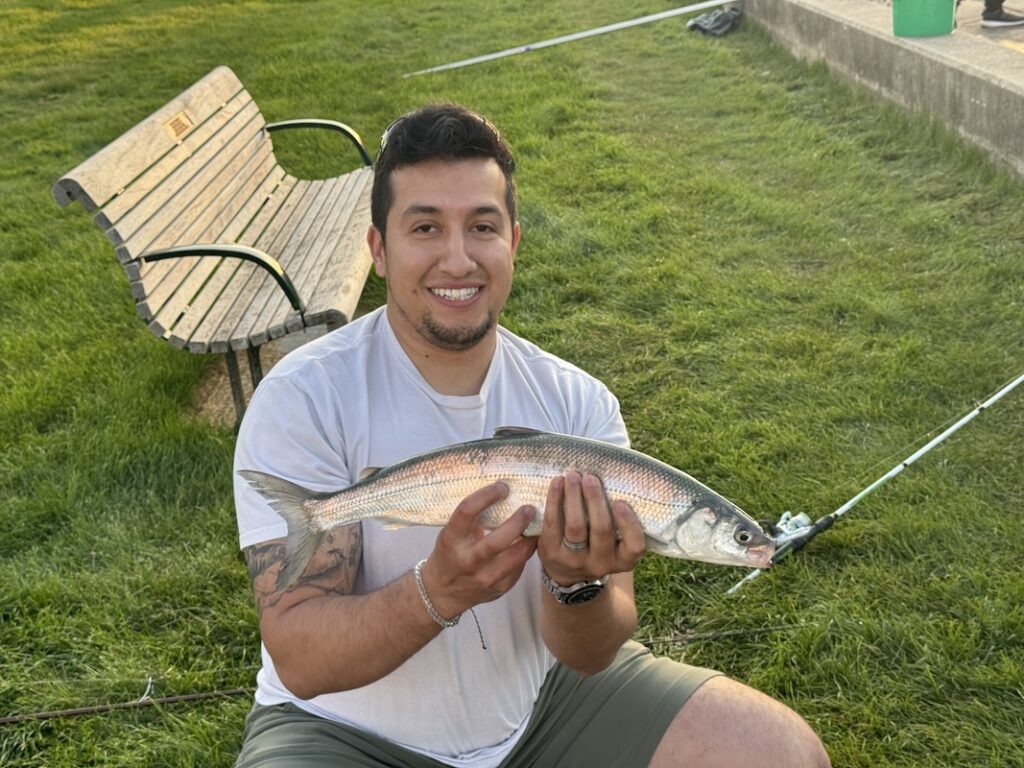
My son-in-law, Niel, caught a few of these.
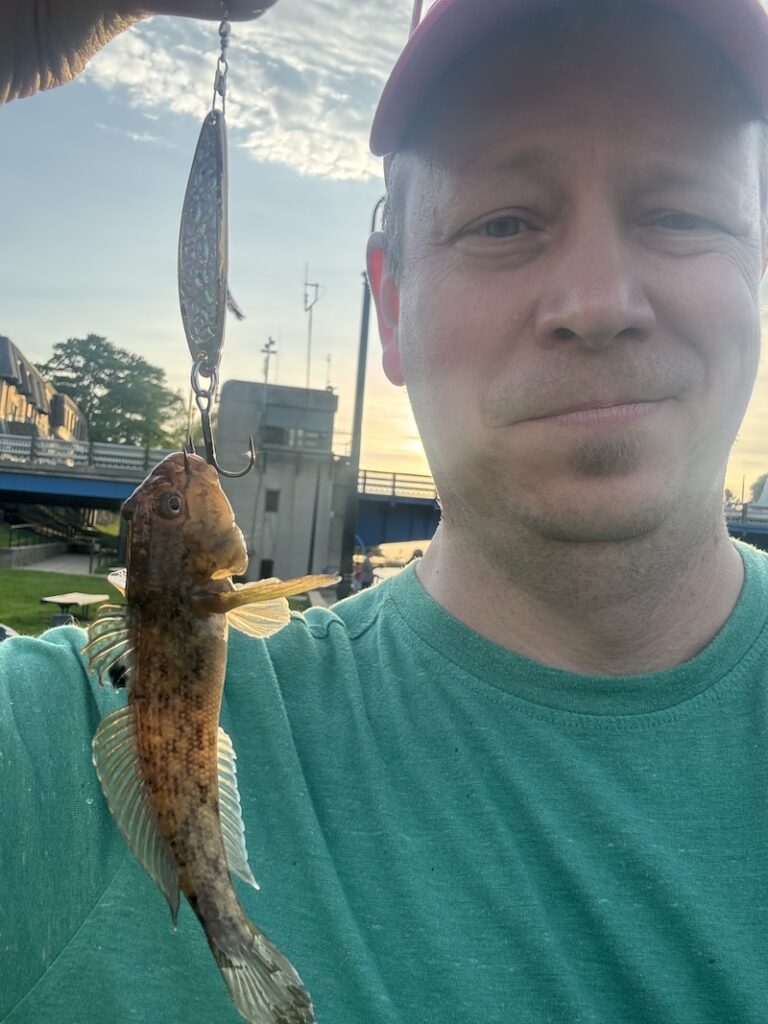
They both caught a few Cisco (Lake Herring), which are actually making a comeback in Lake Michigan. I, on the other hand, caught a tiny 3 inch long Goby, which is an invasive species. As it turns out, I’m just not a great fisherman. But more on that in a bit.
When I knew Josh was coming to town in order to go fishing, I knew that was my chance to upgrade my fishing gear. I had a couple fishing poles, but they were very old, and I wasn’t sure if they were even in working order. So like any good hyper-focused ADHDer, I researched for DAYS about what sort of fishing pole and reel I should get, along with the different types of fishing line.
(You didn’t know there were different types of fishing line? Oh you poor soul, perhaps you should stop reading and go research monofilament vs fluorocarbon vs braided line. Then followup with a deep dive on how to properly load your reel with backing line, followed by braid, with a monofilament or fluorocarbon leader, depending on the length and action of your rod. What does action mean, you ask? See, fishing rods have both power and action, which are also affected by the length of the rod itself… wait, what were we talking about?)
-Shawn’s brain derailing the conversation
This monster was my catch that day. The photo is actual size. If you’re reading this on your phone…
So yeah. I got a brand new light power, fast action, 7′ long Lew’s MACH I fishing rod with a matching reel. Honestly, I hadn’t yet gone down the road of researching fishing line when I bought the rod/reel combo, so I just filled it with standard 6lb test fluorocarbon fishing line. I bought an assortment of fishing lures, not really knowing what we were going to fish for, and thought that would be the end of it.
But as my foreshadowing about the nuances of fishing line has already given away, that afternoon of fishing was not the end of it. Oh no. My poor showing when we fished sparked a sort of *need* in me to figure out how to be a fisherman. Fishing, as it turns out, is actually really really complex. There is SO MUCH to learn, and it’s the sort of physical activity that doesn’t require traditional sportsball-type skills. (Unless maybe it does, and that’s why I’m not very good at it… hmm.)
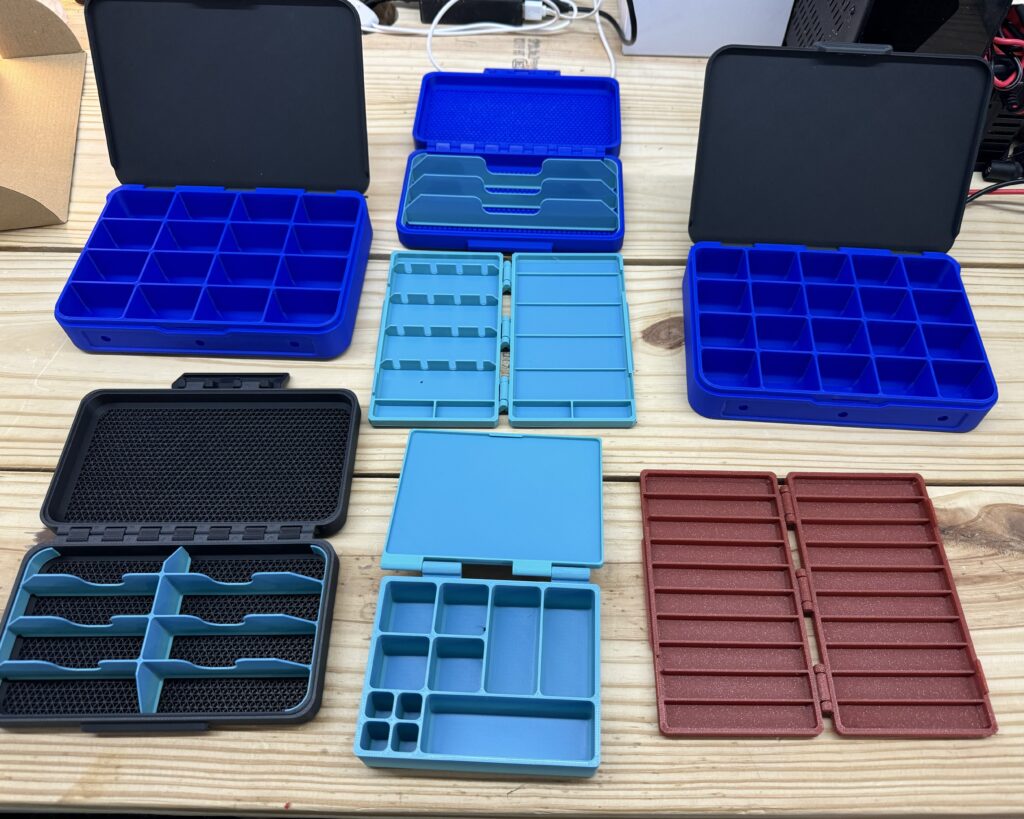
Sadly, this isn’t even close to all the tackle storage boxes I’ve printed. This just all that fit in frame…
Since that fishing trip a month or so ago, I’ve purchased several more fishing rods. I also dug out my old equipment from years ago, and the stuff that was still viable has been cleaned and sorted. I have watched hours and hours of YouTube videos about fishing in different situations, using different lures. I’ve used my 3D printer to print out multiple styles of fishing tackle holders, including inserts designed for Altoid tins for pocket sized travel packs of lures. I’ve mapped every body of water in my area that has shore-accessible fishing, and tried multiple apps designed for knowing the best places and times to fish. And I’ve attempted to fish in most of the places I’ve been able to find, including roadside bridges on tiny creeks using ultralite fishing equipment.
Yeah. I’m deep, DEEP into an ADHD hobby spiral, and it doesn’t look like I’ll be out of it any time soon. That said, it’s been pretty frustrating, and I have zero desire to go ice fishing in the cold. It’s likely this new obsession will pass with the season, and when the snow flies I’ll be well into another quirky pastime like gelato making or blindfolded martial arts. While I’m still in this obsession, however, here are a few things I’ve learned:
Even though I live in Northern Michigan, surrounded by more freshwater than most places in the world, there are a frustrating lack of places one can fish from shore.
Fishing with live bait doesn’t really appeal to me. I think the idea of using a lure feels more sporty, and the vast array of lures makes for so much to learn about each type and their use cases.
I also just catch and release. I don’t want to clean and eat fish I catch. I much prefer to let them go. That’s just me though, I don’t begrudge anyone who wants to eat what they catch.
Based on how often Donna will come with me while I fish, only to sit in a camp chair and read a book, it’s proof that I married SO VERY WELL. Seriously, I don’t know how she puts up with me.
Catching occasional fish, even tiny fish, makes the whole experience enjoyable. If you get skunked 3 or 4 outings in a row, it can get really frustrating. Yes, the fishing is still fun, but never catching a fish is just an emotional kick in the crotch.
Fishing is HARD. Well, that’s not true. CATCHING FISH is hard. So maybe, “FISHING WELL” is the thing that is difficult.
Honestly, as obsessions go, there are plenty of worse options than fishing. Getting outside is something I don’t do often enough, so that alone is probably healthy for me. I sorta hope I do keep interest in the hobby. It’s fun, and if I actually get better at it, I could potentially make it fun for others too. There are few things I enjoy more than helping other people succeed, so if I’m eventually that guy who can kickstart a healthy hobby for someone else? Well it might be one more way I take advantage of ADHD, instead of suffering from it.
Now if you’ll excuse me, I need to look up gelato recipes…