Hank Green Ruined My Bunny Slippers

If you’re anything like me, well first off, I’m so, so sorry. But if you’re like me you appreciate sparkling water, especially now that it comes in a plethora of delicious artificial flavors. I’m not a snob, either. I like the LaCroix, the Bubly, StoreBrandica — it’s all delicious.

But, it’s also a bit spendy. It hurts me every time I spend $6.99 for a pack of (8) 12oz cans of water. Yes, they are usually painted in pretty colors, and come with pre-dissolved carbon dioxide and 3 drops of chemical flavoring; but it still feels like I’m paying a lot for something so very simple. (If you add the 10 cents per can for the Michigan deposit, it’s even worse, because I’m nowhere near responsible enough to take my empties back to the store. Seriously, if you’re a Boy Scout troop or a Little League team doing a fundraiser, stop at our house. We have 537 bags of empty cans piled in the back room.)

So anyway, in an attempt to Hackzor The Planet, I bought a Soda Stream machine (The “Source” if it matters, but I think they’re all exactly the same thing, I’m not sure why they have so many models. THEY DO ONE THING.) I figured if I could make my OWN bubbly water, I might be able to find flavors and stick it to man! Actually, I don’t know if a man owns LaCroix and/or Bubly. But saying, “stick it to the person” seems less revolutionary and more pin-the-tail-on-the-donkey. But yeah, I bought a Soda Stream machine and a set of (3) reusable bottles. Because I love the planet. Of course those bottles are made of plastic, so maybe I hate the planet and just want to save money? I dunno, it failed anyway (he foreshadows like a BOSS).

I tried to find “flavor drops” that would make my homemade bubble water taste like something other than salty fizz. (Also why does carbonated water taste salty? There’s no salt… There’s carbonic acid, but why does that taste like salt? Shouldn’t it taste… acid-y? Or carbonic-y?)

So, flavor drops. The only thing I could find was some co-branded thick goo from the Bubly company, which you add a surprisingly large amount of to your freshly carboned water. It’s supposed to be just like the cans you buy at the store, and with the cost of those little bottles of goo, it certainly should taste like Bubly, because it costs just as much. Also, they only come in the lamest of flavors. And I didn’t want Bubly, I wanted something different. And cheaper.

Then I found these Capella brand drops, which come in a crazy variety of flavors. They seem perfect, so I bought a LOT of them. If you go directly to their website (instead of that Amazon affiliate link), they have even more flavors. Some sound better than they taste, and some taste exactly like you’d expect. My favorites are the gummy bear flavor and the Swedish Fish flavor. (I think they’re called something similar to the brand name, but not exactly so they don’t get sued — but that Swedish Fish flavor is pretty gnarly to drink in bubbly water.)

Unfortunately, every flavor adds a sort of “waxy” flavor to the water. Waxy might not be the right word, but they don’t seem to have the same sort of delicious flavor that store-bought cans have. I know they’re artificial, but the store brand flavors seem more “real” somehow.

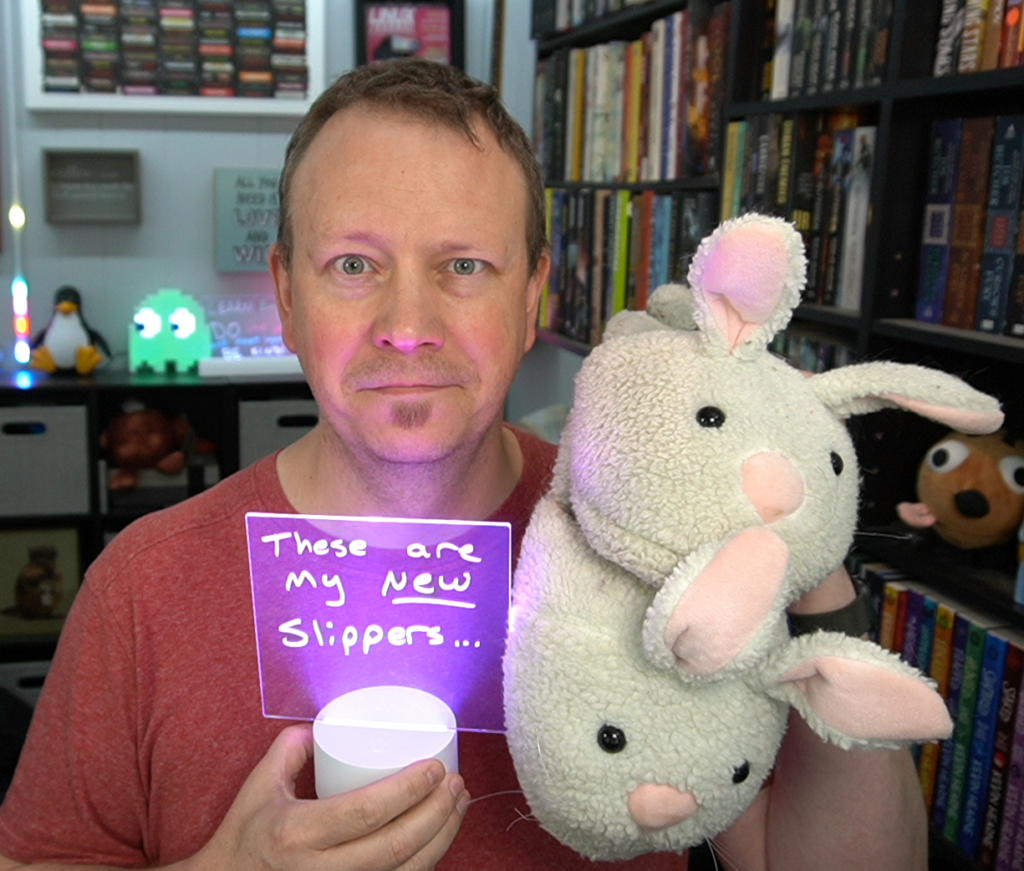
And that’s when Hank Green ruined my bunny slippers.

I’m a fan of John & Hank Green. That’s no secret. Anyone in Nerdfighteria worth their salt is familiar with the podcast they do together, “Dear Hank & John.” I’m even a $5 Patreon supporter, so I get a *bonus* podcast every time they record an episode. Totally worth the price on the tin. Anyway, during one of the episodes, Hank was talking about how he also enjoys LaCroix-ish things. Like me, he has tried to make his own concoctions from home. (OMG we’re so alike, we should totally be BFFs… just sayin) During one of the episodes, Hank said that he adds some orange juice concentrate to his SodaStreamed tap water. Now don’t get me wrong, I know that fruit juice of any kind is just sugar water, and it’s not, “good for you” in any significant way. But still, it sounded like a pretty great idea.

And so I bought some orange juice concentrate. And I did it with aforethought, y’all. I got pulp-free, because while Fizzy Floaters might be a great band name, chunky bubble water sounds pretty gross. I also bought the kind that comes in a plastic container. Not because I hate the planet (although we established above that maybe I do…), but because I didn’t want the cardboard to get weird and soggy. Anyway, I put the plastic, pulp-free concentrate container in the fridge so that it would be pourable. The next day, along with my cup of coffee, I decided to prepare an all-natural carbonated bottle of slightly orange-y water. Unfortunately, Hank did not specify how much concentrate he adds to how much water — but I thought this was a, “less is more” kind of situation. I didn’t want carbonated orange juice, I wanted carbonated water with a refreshing hint of citrus. So after making a bottle of plain bubble water, I slowly poured a tiny bit of the concentrate into the bottle.

Now, I’m not sure if you know how science works. I thought I did. And Hank is “The Science One” when it comes to the Green brothers. But in some sort of Mark Rober inspired reaction, my innocent bottle of sparkling water turned into a fountain of citrus and shame that makes Mentos and Diet Coke look about as exciting as those weird ash-snake firework things that come in the cheap 4th of July fireworks packs. The explosion that took place on my counter hit the kitchen ceiling. Much like an untethered rocket ship, the bottle of fury fueled by some sort of zero-point energy launched its frothy exhaust into my pouring hand, which shot the mostly full container of concentrate against the side wall of the kitchen. It had enough force behind it that it bounced off the wall, and came back (still about half full) to hit me square in the chest and get further accelerated by the now spinning bottle of fury on the counter.

Further experimentation should be done, because I think the OJ concentrate combine with the freshly carbonated water created some sort of Jesus-level loaves and fish situation. That single 20oz bottle of water somehow left about 5 inches of angry standing water in our entire kitchen. The rest of the orange juice concentrate dumped directly on my slippers and my cup of coffee somehow poured itself *into* one of my slippers during the 7 seconds of chaos.

So yeah. That’s how Hank Green ruined my bunny slippers. And I have no idea if his Molotov Cocktail of Doom actually tastes good, because all of the ingredients were now a permanent part of my kitchen decor.

The moral of the story? Um… I dunno. Stock up on LaCroix when it goes on sale?

The Real Reasons I’m a Creator

Subscribe: Apple Podcasts | Google Podcasts | Spotify

I’m not going to lie, it does feel a little silly when people in my meat-space life find out that while I do have a day job, the vast majority of my energy goes into creative endeavors. Being a YouTuber at 48 years old smacks of midlife crisis, and being a small YouTuber feels somehow even sadder.

This is probably where you’d expect me to get all noble, and say that I’m not creating content for monetary gain. I’m doing it because I want to make the world a better place. I want to share knowledge, and I want to provide skills in order to help other people do good things. A rising tide lifts all ships, and that sorta thing. And that is true, to an extent. But the thing is, I do actually hope to make an income in order to allow me to do all those noble things. The money isn’t really the *reason*, but it has to be a part of the process. I wish it weren’t the case, but it is. Largely because I can’t work full time and also be a creator forever. I’ve been doing it for a year and a half now, and while it’s been manageable — it’s a lot.

I also want to support my family as a creator, because I need to have some flexibility when it comes to mental health. Yes, part of that means I occasionally need a “day off” for mental health (Donna and I are staying in a cabin for 2 nights later this month, which will be the first vacation we’ve had since 2019, and even then it was a single night out for our anniversary). But more than that, I need the flexibility to fail at human-ing from time to time.

My official diagnosis is Severe Inattentive Attention Deficit and Hyperactivity Disorder. (the double whammy of “inattentive attention deficit” seems a bit mean, but whatever) And while medicine doesn’t help me very much, the knowledge of the condition has helped me navigate life with severe ADHD a lot better. But while that’s the loudest part of my official diagnosis, I also have an even more insidious diagnosis of Major Depressive Disorder. It’s quiet, dark, shameful (not really, but it feels that way), and it rears its ugly head during the worst possible times.

I usually just knuckle under and push through the depression. And while it both rips up my insides while also making me numb, for the most part I just accept it. Too many people are depending on me, so not showing up isn’t an option. Sometimes it’s bad enough that I can’t hide it from those around me, and they know I’m miserable — but they also don’t know how to help. Because they can’t. And if you’ve been following me as a creator, those odd multi-week stretches of really low productivity? Yeah, I’m doing my best to hang on. My dayjob is such that I can manage to keep servers going even if I’m painfully numb, but being creative is mostly not possible. Showering is mostly not possible.

And I realize the irony of wanting to be a full time creator in order to help deal with my mental illness — when I JUST SAID that I could do my dayjob even in a depressive funk. But the thing is, it doesn’t mean I’m able to heal. It just means I push it down enough to move forward. Surviving and living are different, even if the Venn diagram has significant overlap. I need to be able to flake, and still be providing value for others and security for my family. And so that’s why I’m building a library of content. And why I want to continue building that library, and the community of people who care about learning; because if I’m your employee, I’m apt to let you down. But if I can share my insights, knowledge, quirks, silliness, skills, and kindness with you? Perhaps that value isn’t tied to how many hours a day I work.

I do believe my work provides value. Some days I think that value is more or less than other days (depression, you see, is a crafty liar). And so I want to be a creator so that I can share all the valuable parts of me. My hope is that when I’ve built up enough of that value into consumable content, if I flake for a week while I stare at the ceiling, I won’t feel like I’m stealing from those people who support me. I want to disconnect my value from the hours I’m present, because I’m built in an unreliable way.

Anyway. Maybe it’s a midlife crisis. If it is, that means I’ll live to be like… 96 years old, which would be AWESOME. But whatever it is that convinced me creation was my path from here, I’m grateful. It’s scary, and uncertain — but it means I get to share the parts of me that I think others might find valuable. And every time you find value in something I’ve created, you punch my depression in the junk. Because it tries to tell me I’m a burden and provide negative value to those around me. And that is a lie. A lie which calls for a junk-punch.

So if you’re reading this, thank you for punching my depression in the junk. He’s a total douchecanoe, and deserved it.

RedHat: Rocky Times with its Alma Mater

Subscribe: Apple Podcasts | Google Podcasts | Spotify

Intellectually, I understand the importance of Open Source licenses. The nuances of GPLv2 and GPLv3 can change the entire way a piece of software is used, developed, and shared.

But I don’t really care all that much.

Sure, I lose a lot of “cred” when I dismiss licensing so offhandedly. How can I call myself an Open Source evangelist, or even an enthusiast, if I don’t have thoughts on licensing? Honestly? It’s because I’m not passionate about Open Source Software due to its legal allowances and limitations. Heck, I didn’t even build my career around Linux because of software at all. I’m an Open Source advocate because of people. Period. End of sentence.

Does that make me anti capitalism? Against monetization? A GNU/Linux zealot? Nope. But it also doesn’t me pro-capitalism, entrepreneurial, or a Microsoft fanboi. It basically means I don’t care a whole lot about the non-people-parts of the entire movement, or community, or vertical marketplace. I don’t even really know what a vertical marketplace is, or if I made that up. I love Open Source because it changed my life, and never asked anything in return. And the “it” that changed my life, really means people.

In 1999, when I had my car accident, the aftermath was pretty grim. I’ve told the story countless times, but the headline version is, “Woman in 5th month of pregnancy forced to bus tables in order to support family of 3 as main breadwinner battles against head injury, no longer able to leave the house, much less work.”

When I tell the story, whether on a podcast, to a news reporter, or in the posts on this very blog, I jokingly say that I learned Linux because it was all I could afford. But if I wanted to learn other products, I could have found a way to “get” those software packages. And while I wish I could say it was my pristine moral standards that made me settle on Linux instead of pirating commercial products — that would be a lie. It was because Linux, and by extension Open Source Software, was purposefully designed to give me everything I might need, for free. And then when I needed help, provide that help whether I could afford to pay for it or not.

I could have pirated Microsoft Windows Server, but I couldn’t call Microsoft to ask questions about setting up an Active Directory! Yet, if I wanted to know how to make two Linux machines share user data, I could reach out to folks for help on NIS/ypserv/ypbind, and if I said I was just trying to figure it out, they’d be MORE excited to help me. And perhaps it is the licensing that created that sort of community, but legalese doesn’t garner my gratitude and respect. Kindness does. Kind people do. And that’s why for the past several decades, I’ve built my career around Open Source Software.

RedHat recently made news by deftly tiptoeing through the GPL (I don’t even know or care what version), and legally restricting people from taking their source code and compiling clones of their commercial, flagship version of Linux. Their rationale is that groups like Rocky Linux and Alma Linux were simply taking RedHat’s hard work, repackaging it, and giving it away free. Which… is true. For many Linux users, that’s simply what Open Source meant. RedHat took the work of others and created their commercial product, but since they used other people’s work, they had to release their work as well. In fact, RedHat has been one of the few companies to make incredible amounts of money selling a product that companies could get for free. Their support, both in making the distro and in integrating after the fact meant they could add value beyond their code itself.

But it seems they weren’t making the amount of money they thought they should be making, and so using legally-allowable restrictions, have stopped the proliferation of clones. Some giants in the community think they’ve violated at the very least the spirit of Open Source. Others (several of whom I respect) have taken a more corporate-sided stance on the issue.

Me? It just makes me sad. And before anyone responds with, “If it weren’t for corporate money, Linux and the Open Source community wouldn’t even exist!” — I’m not sad about RedHat protecting their financial interests. I’m sad because the kindness of Open Source has been tossed out in order to… make it successful? Have Rocky and/or Alma been taking advantage of RedHat? I have no idea. Really. But it was the community of people working together in order to make sure everyone could play that takes a hit.

I can already hear the response that RedHat allows people to use their commercial product for up to 16 servers without paying for a license! And yep, that’s true. But the joy of Open Source used to be not worrying about licenses in order to participate in the global, shared experience of working together. I didn’t fall in love with Shareware, I fell in love with freedom.

Our community has been built around people contributing in whatever ways they can, and at times, by only participating. I’ve never contributed code to any project, but I’ve written and edited for Linux Journal. I’ve never done a pull request on a kernel module, but I have spent the bulk of my career teaching people how to use Open Source to make the world a better place, one person at a time.

My contributions to Open Source, and the world in general, doesn’t have a clear business plan. While I’ve been paid for many of the things I’ve taught and created, monetization has never been the reason. If making money motivated me more, perhaps I’d have more of it, and my voice would be heard in more places. But a rationale isn’t the same as a motivation. My YouTube channel is monetized, and that’s my rationale for investing the time into making videos to help people. But I assure you, I haven’t spent every spare moment this past two years making videos so I could bring in $150/month in YouTube ad revenue. That revenue is nice, but it’s not what keeps me excited. When someone leaves a comment that they finally understand octal notation and sticky bits after watching my video — that is what motivates me.

It’s the people. It always has been.

So am I on RedHat’s side? Am I on Rocky Linux’s side? Not really. I’m on the side of working together to make the world a better place. I’m on the side of kindness for no reason other than a kind world is a world I want to be part of. Maybe RedHat’s contributions have made my particular livelihood possible. Maybe not. But we have different motivations, and gauge success by different metrics. That’s OK. But it still makes me sad.

Better Class of Loser

Subscribe: Apple Podcasts | Google Podcasts | Spotify

A couple days ago, I tweeted about ADHD. I do that kind of often, because I was only recently diagnosed. That doesn’t mean I recently “developed” ADHD, that’s not how it works. It means that a condition I’ve had my whole life was diagnosed after a long (and expensive) battery of tests and interviews.

There are people who think ADHD isn’t really a thing, or that it’s just laziness, addiction, technology-overload, or lack of exercise. But while some or all of those things might be intertwined with ADHD, at the very least it explains why some people are more prone to those eventualities. And while a *cause* for poor behavior and/or performance isn’t an *excuse* for it — having a frame of reference for why a person behaves the way they do is foundational to building the skills required to live a productive and fulfilling life.

No one would suggest a blind person keep getting stronger and stronger glasses, or brighter and brighter lights. That’s silly. But if someone has ADHD, it’s just as silly for them to just “buckle down and focus”, because it’s not willpower they lack, but the executive function to manage tasks in a traditional way. When I referred to myself as “kind of a loser” — it wasn’t me trash talking myself. (I do that sometimes, I know, but this wasn’t that) It was me recognizing that while an ADHD diagnosis is earth-shatteringly beneficial to how I do life, it doesn’t fix 46 years of poor coping overnight.

I’ve had a really good paying job for most of the past 10 years or so. And yet, we’re in massive, almost unsurmountable debt. Realizing that folks with ADHD are often terrible with finances for a multitude of reasons explains some of that, and gives us some insight on how we might effectively change how we do things in the future. But it doesn’t get rid of the debt. That’s sort of what I was getting at with my tweet.

I have a terrible time staying on task when it comes to work. I shine when things go sideways, which makes me very effective during disastrous situations — but I struggle horribly on a normal day. Knowing that I have ADHD helps me realize that I’m not a garbage human being, but it doesn’t automatically train me to deal with my shortcomings. That will take time, and it won’t be easy or quick. And even when I do develop tools and strategies to rely on my strengths while protecting my weaknesses, I’ll still fail. Maybe just not as often. Eventually.

So while I’ve managed to get some really great jobs, I’ve also managed to make some really terrible choices. Now I see those choices for what they were — poor choices, but also uninformed poor choices. As I learn to drive this crazy non-typical brain properly, hopefully my future choices will be a little less destructive.

It’s amazing the amount of success I’ve had in my life. And I like many aspects of who I am. But undoing 46 years of collateral damage and unlearning a lifetime of dysfunctional coping strategies is a lot. So I tend to shout at the clouds a bit, like in the tweet above.

My catch phrase is directed at myself at least as much as it’s meant for others. Learn everything, do what you love, and most importantly, be kind. That last part includes being kind to yourself.

The Scholastic Book Fair

Subscribe: Apple Podcasts | Google Podcasts | Spotify

I ran across a tweet someone had screenshotted and shared on Facebook recently, and is often my practice, I looked it up so I could give proper attribution to the original author. It turns out the tweet was from 2019, but it’s one of those tweets that only improves as it ages, proving its worthiness by how true it remains.

Now, I don’t actually believe in magic, per se. There are unexplainable things, amazing illusionists, and unimaginable technology that we just haven’t invented yet. But actual magic? In a practical sense, no. But there are a few things which come surprisingly close.

Music, and its ability to tie mathematical formulas to human emotion is about as close to magic as I can fathom. Part of it is how truly brilliant, beautiful music is defined by its perfect imperfections. And part of it is how something so mathematically definable is also pure art.

Speaking of art, it’s not just music, but all forms of art that I find absolutely baffling. Like how the human condition can be somehow quantified and expressed in a medium other than life itself. Whether it’s Mona Lisa’s smile, or Edvard Munch’s “The Scream” (often credited to Van Gogh, but that’s another story altogether) — art somehow defines the part of humanity that is more than flesh and bone.

And books. Books are basically the distilled bits of an author’s soul, inked into paper, as an indelible snapshot of that author in the moment. And books, possibly more than other artforms (for me at least), have the uncanny ability to transport the reader to another place. Another time. Another life. And I don’t just mean fiction or literature — even non-fiction, or technical books can let the reader live inside another human’s mind, even if only for a single train of thought. And that is why this Tweet resonated with me so deeply.

Like I referenced in my re-tweet, I grew up a poor kid. We survived on welfare, living in inner-city Detroit. Somehow, my mom not only got me accepted into a private school in Dearborn, but also managed to drive me there every day. There’s no way she could afford the tuition, and I don’t really know how she managed the gas money to drive the 30 minutes every morning and afternoon. But she did, and I’ll be forever grateful for the sacrifices she had to make in order to make it happen.

But we certainly did not have money for the Scholastic Book Fair books when those colorful flyers were sent home. I’ve seen them as an adult, and for a nerdy little kid who escaped into books; there just couldn’t be much more powerful marketing. But it didn’t matter, because buying books for entertainment just wasn’t feasible. That was OK, because I’d often walk myself to the library and check out books (which is how I got the love for them in the first place). Still, it didn’t make the lack of book on Scholastic Book Fair day any less painful.

I also mentioned in the tweet that due to a head injury, a car accident in 1999 specifically, I don’t remember my childhood. I don’t remember much of anything before March of ’99, to be completely honest, except for a few faint flashes of memory that my brain may or may not have recreated as a memory based on something someone told me. (Memory is a funny thing) But there are some things that managed to stick in my Swiss cheese brain, and my 2nd grade book fair experience is one of them.

Ms. Sanzo, whose first name I likely never knew, was my teacher. Somehow she knew I was a big Smurfs fan, and managed to quietly purchase some Smurf-themed book that was in the flyer that year. I don’t remember the book. I don’t actually remember Ms. Sanzo, apart from a vague mental image of an older woman who took surprisingly little crap from unruly youngsters. But I remember that she gave me the book, somehow relaying that it was really mine, and that she’d taken care of the payment. And the part I remember most is that she did it quietly. I was a poor kid in a private school. That was partially masked thanks to school uniforms, but the vast majority of students in my class were from wealthy families. Being outed as the “welfare case” would have been painful, and somehow she stopped that from happening.

Ms. Sanzo: If you’re still with us, it’s very unlikely you remember the poor, nerdy, bespectacled 2nd grader for whom you purchased a Smurf book. But your kindness, not only in deed, but in method, impacted my life so deeply that it’s one of the few memories I have of my childhood. Your act of love resonated in my life for decades, and forever changed who I became. And continues to play a role in who I strive to be.

Books are one of the closest things to magic that I can imagine. And much like a magic wand is little more than a conduit for magic itself — a book can be a conduit for kindness and generosity, assuming it’s wielded by a strong enough magician.

If you can help a child get a book, I encourage you to do so. You might just change the whole world. Or, just one small life. Either would be magical.

Green Hair, Mustard Seeds, and Me

Subscribe: Apple Podcasts | Google Podcasts | Spotify

It’s been a couple weeks now, and my green hair is starting to fade. My light brown roots are peeking through, and since I don’t go many places, most people who will see me have seen me. And while I tweeted a short explanation, I haven’t gotten too detailed when explaining why my hair is green. Mostly because I was (am) angry, and it was hard to talk about it without being mean. And that rationale is sorta the whole point.

In order to really understand my green hair, however, you need to understand me a bit. I don’t really talk about my faith much publicly these days, and that’s been on purpose. Largely because what “Christian” seems to mean in society these days doesn’t really align with what it means to me personally. But also partially because I’m not a man of great faith. When I see Jesus talk (twice) about having faith as tiny as a mustard seed, my first thought is something like, “um, what about people with the faith of a basil seed?” (full disclosure: I haven’t gardened very much, basil seeds are probably not the smallest, they’re just the smallest I’m familiar with, and MUCH smaller than mustard seeds)

Shawn, Let Me Explain Matthew 17:20…

Please don’t. I already know. I really do. I’ve taught bible class, led youth group, served on deacon/elder boards, and heck even preached Sunday sermons. I’m familiar with conventional wisdom on the metaphor, and I’m not claiming that I’ve discovered some new, deeper, more holy meaning. No, when I consider the notion of small faith affecting change, I’m encouraged in spite of the biblical focus. Jesus was stressing that God is so great, even the smallest sliver of infinity is still infinity. (See? Old habits die hard. Here I am preaching…)

But what if my small faith is combined with weak belief and mountains of uncertainty? Is my basil seed of faith still enough to move mountains? Maybe. And, maybe not. The thing is, I still need to live my life in a way that seems right. And let’s be frank here, when I say “weak belief”, I’m not just throwing out church-y phrases. Do I believe in God? Sure, usually. I guess. But pretending to have a rock solid faith for the sake of saving church ladies from “the vapors” seems a bit un-Christian. Heh.

Bro, Do You Even Christian?

Yes. Yes, I consider myself a Christian. But only because Jesus seems to be someone worth following. Whether you think Jesus was/is the creator of the universe, becoming a man to redeem the world, or just a rebellious lover of humanity — he was a really awesome guy. I want to be like him, because he cared about the outcast, taught people to think instead of blindly obeying, valued people over anything else, and got furious at the exploitation of human beings by those in power. And Jesus was kind. He must have been, or the children wouldn’t have flocked around him.

So yes, while in many, many ways I do not identify with the modern, American version of “Christianity”, I do consider myself Christian. Maybe not a “good” Christian. Maybe not even a good representation of “Christ-like”, but inasmuch as I’m anything, I’m a person trying to be like Jesus. And most days, that’s enough for me. To be clear, that’s not enough for many folks, and so many will not consider me a Christian. That’s OK.

But Dude, if You’re Wrong [Insert Crackling Fire Sounds]

Yeah, so if you’re a Christian to avoid burning in Hell, you’ve missed the point. Maybe Hell is a place of fire and pain, maybe it’s a metaphor for separation from God. And maybe it’s simply a description of the empty worthlessness a life lived for selfish gain gets a person. I honestly don’t know. But I also don’t need to know.

The way I strive to live my life is not predicated on a promise of future reward. I don’t choose kindness so that someday I’m given an oceanfront view in heaven. Empathy is not a vehicle to riches, in this world or the next. And my motivation for helping others is not accrue favor from a higher being, but rather to, you know, help someone because they need help.

For what it’s worth, this is also why I’m far less concerned about people who aren’t Christians than traditional Christianity would dictate. And here is where I lose a lot of folks who were mostly ok with my particular take on living a Christ-like life. That’s OK. I’m not starting my own religion, and I’m not telling anyone they should “Christian” like I do. But here’s the thing, Jesus didn’t seem to be a guy overly concerned about technicalities. If there is an afterlife, and some metaphorical pearly gates, it seems like a pretty low-rent heaven that would allow douchebags with the proper punch card into eternal glory, and send caring, compassionate Hindus, Muslims, Jews, Atheists, etc., into eternal torture.

Does that mean I’m trying to do some magic hand-wavy trick to turn “the way, the truth, and the life” into a moralistic litmus test for heaven? Um, no. I don’t feel a need to do that. Again, my motivation for how I live my life is not a future reward. In fact I’ve always been suspect of folks who need that carrot in order to do the right thing. My little basil seed of faith is apparently sufficient to follow the example of Jesus, even if he doesn’t want to be friends with me afterward.

Ok. You’re Outta the Club

I know. No, seriously, I know. Writing this and posting it publicly will actually be sufficient cause to prevent me from holding a role as teacher or leader in a church. It will be a rationale for people who have been uncomfortable with my brand of living life to finally put me in the “other” camp. It might sever friendships, and it will disappoint people who thought I was someone else.

But that’s OK too.

I am a Christian, because I think Christ is someone worth following. I think the modern Christian Church resembles the Pharisees in the bible far more than it represents Jesus and his gang. And I can’t pretend to be something I’m not in order to fit in. That really doesn’t seem like the sort of thing Jesus did either. My faith might be tiny, but my resolve is not.

That Was a Lot. But, Why is Your Hair Green?

Heh. You still want to know? Cool. It’s difficult to explain without painting some folks in an unflattering light, but my hair is green because my daughter was treated poorly for dyeing her own hair. She was a volunteer assistant coach at the Christian school from which she graduated. Partway through the season, when she dyed her hair bright red, she was told she could no longer represent the school in public. There was a new rule, which she hadn’t been told about, that volunteers were not allowed to have unnaturally colored hair.

The rub, however, is that she was still allowed to help in practice, just not sit on the bench during games, or get announced as a coach during the pre-game. Her “look” was appropriate enough to exploit for free labor, but not “good enough” for the public to associate with the school in an official role. And she was gutted. So I dyed my hair in solidarity.

So What Now?

I dunno, coffee? I mean, it’s not like I’ve suddenly changed who I am, and my life is on a different trajectory. If I haven’t been living my life loud enough that people are shocked to learn I was a heathen all along, well, maybe things change for them. As for me, I’ll continue to live life the best way I know how. When presented with new information, I’ll change my views accordingly. If given a choice between kindness and and cruelty, I’ll strive for the former, while rallying against the latter. And with all my shortcomings, failings, poor choices, and inevitable mistakes: I’ll try to leave this world a little better than I found it. Regardless of where my next stop might be.

The Wonder and Misery of Empathy

Subscribe: Apple Podcasts | Google Podcasts | Spotify

I think empathy is one of the most valuable skills or traits that we can master as human beings. It allows us to see beyond ourselves, and function as a group in a way that allowed society to develop. At some point, however, we started seeing empathy as a weakness. I’m not sure when it happened, or the exact mechanism that brought it about — but the almost magical ability for humans to internalize and understand the situations of others turned into a “hinderance” to the advancement of… something.

I hope it’s part of some strange societal pendulum that can swing back. Because when we value and understand the struggles of others, it helps us advance as a group, instead of just changing our relative success by pushing others down. A rising tide lifts all boats, and all that. But building a civilization is a long game, and especially short term, it doesn’t always make logical sense for the players to empathize with each other. Perhaps that’s why empathy is seen as a weakness, instead of the world-changing gift it is. Empathy makes us see each other as one, rather than focusing on our individual short games.

But Empathy Sucks

When I was around 8 years old, I visited my dad. He and my mom split up when I was very young, but when I turned 8 I got to fly out to Colorado and spend a few weeks with him. When I arrived, he gave me my very first pocket knife. Along with the coolest gift an 8 year old could imagine, came a sharpening stone and a lesson on how to keep the blades sharp. Because, I was sternly told, there’s nothing more dangerous than a dull knife.

I didn’t really get it at the time, but dull knives tend to slip when they don’t cut cleanly. And slipping means the potential for cutting yourself or others. The point was driven home the next week when my dad bought us both some beef jerky from a roadside stand. He opened his pocketknife, and cut off a piece of jerky, holding it between his thumb and blade, easily cutting off a piece to pop into his mouth. I’d been spending the bulk of every day whittling any stick I could find, and so my blade had gotten a bit dull. When I tried to cut a piece of jerky like he demonstrated, I had to sorta saw the blade back and forth toward my thumb while squeezing with all my might. Thankfully I only gave myself a little cut as I see-sawed the blade — but the salty beef jerky combined with the disappointed stare from my dad was enough drive the point home. It’s important to keep your tools sharp.

Empathy is much the same. When you keep your empathetic skills honed, it’s more likely that you’ll be affected by the suffering of others around you. A friend of mine is currently struggling with one of their teenage children. Behavioral issues, violence, and all the things you hope to never experience with your own children. As I try to empathize with this friend, it hurts. There’s very little I can do apart from offer a kind ear, and a safe place to scream — so by understanding and internalizing their pain, it causes me pain too.

Plus, when I look at the world as “us” rather than “me/them” — it forces me to make decisions, big and small, based on how they might benefit everyone. Or at least not negatively affect others just to provide personal benefit to me. And, if I stopped this blog post here, you might not see empathy as a weakness exactly, but at the very least a burden. And sure, in some respects, it hurts when you empathize the hurts of others. But the opposite is true too.

Empathy is a Ticket to Celebration Town

When you’re empathetic toward the situations of others, you suffer when they suffer, but you also win as they win. If you’ve ever secretly been jealous when someone you know has something incredible happen to them, that jealousy can flip to joy with a bit of empathy. Allow yourself to imagine the joy they’re experiencing, putting yourself in their shoes, and just like taking on other’s pain — you can share in their joy.

Watching these videos, it’s hard NOT to share in the joy of little black girls seeing The Little Mermaid look just like them.

The crazy thing is, empathy even works with your competitors. Did your team recently lose a hard fought battle against a team that was less skilled? That stinks. But imagine how those players feel winning a grueling competition against a team that was better than them?!? Don’t get me wrong, even the most empathetic among us still get frustrated, still get angry, and despise the injustice we see around us. Losing a game you should have won certainly seems like an injustice, and perhaps it is. But seeing each other as part of a bigger “us” rather than a separate “them” can take the sting out of such things a bit.

Look, Some People are Horrible

But Shawn, what about people who purposefully (and successfully!) get ahead by pushing others down? Why should we choose to empathize with others, when so many take advantage of people and then succeed when they do so?!? How can I “empathize joy” for someone who buys a yacht while their employees have to pee in Gatorade bottles because they’re not allowed time for bathroom breaks? Am I supposed to feel happy for the people who scam the elderly out of their money? For drug dealers with mansions squeezing addicts into crime?

Whoa there, Shawn’s cynical alter ego. No. No you’re not supposed to be happy about those things.

When you’re being empathetic, those ill-gotten gains are not joyful. In fact, I don’t think it’s real joy at all. The sort of happiness you get from greed and blind taking-at-the-expense-of-others is a pretty hollow brand of joy. If you’ve ever experienced joy while other people are also happy FOR you, it’s a night and day difference. No, in those frustrating circumstances above, we do empathize — but with the people who were swindled, or squeezed, or exploited. And we use that pain and frustration to make the world a little bit better for us as a group. We use that righteous anger to make systemic change which lifts everyone’s boats. In the words of Mahatma Gandhi:

That Was a Great Ending to the Blog Post. Why are You Still Writing?

I know, right? Ending with a Gandhi quote wraps it up nicely. I’m totally ruining the vibe. But, Gandhi didn’t actually say that. It’s a paraphrase. And it’s not a terrible paraphrase, to be honest. I think the mis-quoted quote is powerful and succinct. But it’s easy to miss the bigger point he was making. Here’s the actual quote, from which is where the paraphrase is taken:

“We but mirror the world. All the tendencies present in the outer world are to be found in the world of our body. If we could change ourselves, the tendencies in the world would also change. As a man changes his own nature, so does the attitude of the world change towards him. This is the divine mystery supreme. A wonderful thing it is and the source of our happiness. We need not wait to see what others do.”

– Mahatma Gandhi

See, it was a call to action — but perhaps a bit more complex than just a motivational call to activism and policy changing. It certainly means those things, but Gandhi was clearly talking about changing ourselves. By changing who we are, and how we see the world (specifically for this blog post, how we see other people), we effectively change the world.

Yes, by changing ourselves we only change a very small part of the world as a whole. But we each have our sphere of influence. And kindness, empathy, and genuine care for others is the sort of fulfilling lifestyle that is hard to ignore. My hope is that it’s contagious. And unlike the sort of viral spread we’ve seen over the past few years, an epidemic of empathy is something we should never vaccinate against!

If You Can’t Do Something Perfect…

Subscribe: Apple Podcasts | Google Podcasts | Spotify

Just don’t do anything at all? Yeah, I’m pretty sure that’s not a healthy motto to live by, but it sure does resonate with me. I’ve always struggled with perfectionism, and it sorta ambushed me this week. It’s been a while since I’ve been paralyzed by it. That’s mostly because my creative efforts of late have all been on my own dime, burning my own time.

But that changed this past week.

After literally months of stalling, last week I opened a Patreon page. Within moments, I had multiple supporters, or “Patrons”, and it was both humbling and flattering at the same time. People actually supporting me with their money smacks a little different than people being supportive in general. It’s a sacrifice real human beings are making in order to facilitate my creative endeavors.

So, of course the things I create need to be absolutely perfect. Because they deserve that, don’t they? They’re PAYING for me to create things both for them, and for others. With that additional income, it means I can invest more time into making even better content. And you see where this is going, right?

It’s currently Thursday. I’ve created exactly zero things this week. And yes, it’s been a particularly challenging week at DayJob, which required writing new code and inventing solutions to very specific problems with our very unique set of needs. So I could soothe my ego by claiming it’s been a super busy week, which of course is why I haven’t been able to let my creative juices flow.

But that would be at most partially true.

Like I said earlier, my perfectionism sorta ambushed me. I’d forgotten how crippling it can be to feel the pressure of expectation. It was a problem when I made training videos commercially, and apparently it’s a problem when I’m being supported by individual patrons too. The good news is I recognize it this time. It took years of poor performance and constant anxiety before I realized what was wrong with me in the past.

So what I’m say is, please don’t stop supporting me, those incredible people who do so financially and verbally/commentarily. I will get back on track in short order, and produce the same inconsistent mediocrity you’ve come to expect from me. (That self-deprecation? Yep, it’s still a feature as well, lol) I’m continually amazed and humbled by people desiring the same sorts of things I do. Luckily for me, those things include empathy and patience. I’ve really picked the best group of folks with which to bond.

Now if you’ll excuse me, I need to publish this before I decide it’s not quite good enough to share…

Shame

Subscribe: Apple Podcasts | Google Podcasts | Spotify

Before I start, it’s important to know that I’m not writing this to convince anyone to send money. We’ll be OK, truly. I’m writing this because much like depression, shame withers in the light. I don’t want the specter of “what if someone finds out” to live in my brain, rent free. And perhaps hearing our misfortune will help someone else avoid a similar one.

In order to understand how someone could have $12,518.42 stolen from them without noticing, it’s important to explain our situation over the past 18 months or so. Because on the surface, the notion of losing that much money and not noticing seems like wealth and privilege at an incomprehensible level. If exposing financial information makes you uncomfortable, you might want to click away, because I’ll be using some real numbers.

In the middle of the pandemic, my job changed. Part of that change included no longer receiving employer-sponsored healthcare. I receive a generous stipend, but it doesn’t come close to covering a solo plan. So we added some out of pocket money to the stipend, and started paying for COBRA. (That allows us to keep the healthcare from my last job, paying the full premium plus administrative fees for up to 18 months)

We also have adult children in their early 20s. They were underemployed thanks to the pandemic, and we have been helping them make ends meet. Plus, Donna’s part-time teaching position was even more part time this past school year. Add to that a massive repair bill on my aging pickup truck, existing debt from our barn experience — and the stage is set for a pretty rough financial gauntlet.

With our new expenses and decreased income, it was clear that we would be making less than we spend every month. We had about $17,000 in the bank, and about $20,000 of credit available across our 5 credit cards. Knowing that would only keep us afloat temporarily, we started doing everything we could to add income while decreasing expenses. Sadly, most of our expenses are fixed, and while we could have canceled Netflix, that small savings in the middle of a pandemic didn’t seem worth it. Anyway, we were going deeper into debt every month, but surviving.

Donna took as many sub positions as she could on the days she wasn’t teaching. I worked my DayJob as a sysadmin, and then started cartooning, writing, and creating training videos for YouTube. While my efforts might smack a bit of mid-life crisis, the bulk of my previous career was making training videos, and I’d been a professional writer for years at Linux Journal. The only oddball item was my daily comic, but since I found the process relaxing, it was almost a daily therapy session for me.

So for the past year plus, we’ve been using credit cards for everything possible, and paying the minimum balance due, with additional payments as more money came in. We knew our credit card debt would rise, and our bank account would dwindle, but the hope was to slow the bleeding until I started to bring in some serious revenue from my after work endeavors. It would certainly take a while, but the clock we were trying to beat was a combination of “not running out of money and credit” plus “we have 18 months of COBRA”.

I’d like to say we had a clearer plan, or even a more succinct goal. Unfortunately, we just had stress, chaos, and a faint hope that “something” would give. Perhaps I’d get a job offer that included benefits. Perhaps the school where Donna worked would offer a medical plan. Maybe my YouTube channel would take off, or my comic would go viral. But what it actually meant was many, many credit card charges, and many, many payments to credit cards coming out of our shrinking checking account.

And that’s how it happened.

Back in September of 2021, lost in our myriad of credit card payments, a new credit card payment posted. “Credit One Bank” took an ACH payment for $182.95 out of our account. That’s about the size of other credit card payments that constantly come out of our account, and at first glace I assumed it was our Meijer credit card, which is a branded card from one of the countless credit companies.

As the months went on, there were more and more payments from “Credit One Bank”, all varying from the $100-$300 range, which again, matched our other credit card payments surprisingly close. Looking back, I should have seen it. Of COURSE I should have seen it. There were 4 days in a row where $182.75 was taken out. And while I don’t remember seeing those payments, I probably saw them and assumed I was looking at the same payment. But I didn’t notice.

See, our account balances were changing in just the way we expected them to change. Our credit card debt was rising, and our bank account was shrinking. That’s not ideal, but it wasn’t unexpected. And so we weren’t suspicious that something was wrong. We saw that our money was going away faster than we hoped, and so we focused harder on making more money, not picking apart our bank statements. Heck, we probably subconsciously avoided looking at our bank statements, because we knew it would only add stress to an almost unbearably stressful situation!

And then this month, August 2022, 11 months after that first “Credit One Bank” payment snuck into our life, we ran out of money. Our mortgage payment bounced because its auto-withdrawal happened a couple days before my paycheck was deposited. I had already moved the posting date, because I saw the writing on the wall, but even that only kicked the can down the road a month. Our checking account was in the red, we’d gotten multiple overdraft fees applied on top (because other smaller payments were trying to clear after the account went negative). And only a couple of our credit cards had credit available at all.

It’s embarrassing. And it sucks. But things like Twitter verification, a Wikipedia page, and a well-known-in-certain-circles name does not always equal the underlying financial success it hints at.

So anyway, my paycheck posted, and our account was limping along in the black again. Since our credit was about dried up, we’d been strategically deciding what to pay and when to pay it. So our credit card payments, even the minimum amount due, had to be timed to our paychecks. And that brings us to this week. Yesterday, in fact. My paycheck wasn’t due to post until today (the 18th), and I was watching our account balance like a hawk, making sure nothing tried to clear before my paycheck was in there. And wouldn’t you know it, Credit One Bank was posting a payment for $168.64.

I KNEW I hadn’t made a payment, because after the mortgage fiasco, our balance was too low for that. And so when I logged in to all our various credit card accounts, trying to figure out why one of them automatically made a payment, I couldn’t find a payment for that amount. Anywhere.

And of course then I started looking at our account history, and quickly realized what I should have realized 11 months ago. Someone was making a credit card payment with our account, but it wasn’t us. Or at least, it wasn’t only us. As I searched the transaction history, I found that over the past 11 months, there have been 54 payments taken out. The dates and amounts are fairly random, but vary from $100-$350 or so. And added together, they equal $12,518.42. It turns out that initial $17,000 we had in our account wasn’t dwindling as quickly as we thought, or at least we weren’t “dwindling” it.

I spent most of yesterday talking to the bank, and to the police. Today I have to drive back to the bank (and hour drive, one way, ugh) to finish closing our compromised account and set up a new one so we can continue making our mortgage payments, car payment, and credit card payments. And now, I need to fight to get money back from “Credit One Bank”, even though in my communications with them yesterday have proven to be anything but helpful.

Our bank, Straits Area Federal Credit Union, has shifted a bit. At first, they told me all they could do was stop further withdrawals by charging me a $25 stop payment fee. But after talking to the police officer as I filed a report, he encouraged me to go physically to the main office, and talk to someone a bit higher up the food chain. I’m glad I did, because now they’re going to reimburse me for the previous 60 days, and for some reason the first 60 days of fraudulent charges. Assuming that happens (I’m signing paperwork today), it will put $4,595 back into my new account. The remaining $7,923.37 will likely never get recovered. But I will be sending all the information to “Credit One Bank”, and hoping they do the right thing. Regardless of the outcome, it will take months before I know anything.

I’m not gonna lie, while that $4,595 will be incredibly helpful in the short term, we’re clearly still teetering on the edge of disaster. Thankfully, there’s a bit of good news in this bleak story.

When summer started, Donna clearly couldn’t get anymore subbing jobs, so she applied for a part time position at one of our favorite places on earth. McLean & Eakin Booksellers. She got the job, and I’ll be honest, I’ve never seen her love what she does more than when she’s working at the bookstore. The owners must recognize how much she was made for the job, and without prompting, called Donna in to offer her a full time, year round position. And believe it or not, this small town, independent bookstore provides health insurance for their full time employees.

Health. Care. Insurance.

Our COBRA eligibility runs out in November, and we did not have a plan for what we were going to do after that. The middling insurance plan I was quoted to buy on our own was over $30,000/yr, and that was without dental or optical. Donna getting a job that provided healthcare was unexpected, and the most amazing news we’d gotten in a very long time. I don’t even know what the plan will look like, but it honestly doesn’t matter, because whatever the benefits include will be more than that nothing we could afford once November hits.

I cried like a blubbering idiot. And that, I’m not ashamed of.

Look, we’re far from being financially stable. My napkin math shows that we have about $65,000 in credit card debt, one mortgage with $60,000 remaining, another with $100,000 remaining, and a car loan with $13,000 still outstanding. My DayJob isn’t in immediate jeopardy, but I maintain datacenters for servers that operate in the cryptocurrency world, so longevity and stability are not guaranteed. But in spite of this current financial setback with Credit One Bank, we actually have a bit more hope than we’ve had in a while.

Donna will be working full time, starting some time before November. My YouTube channel was recently monetized, and while it’s only bringing it $100 or so a month, it’s a start. I’ve been working with an editor about a potential book deal, and while my comic hasn’t taken off — I still really enjoy it, and perhaps someday others will enjoy it too. I’ve even built up enough content on YouTube, that I don’t feel bad starting a Patreon page for people who want to support my creative endeavors. (It’s not live yet, but once I get the patron benefits sorted this week, it might be one more trickle of income)

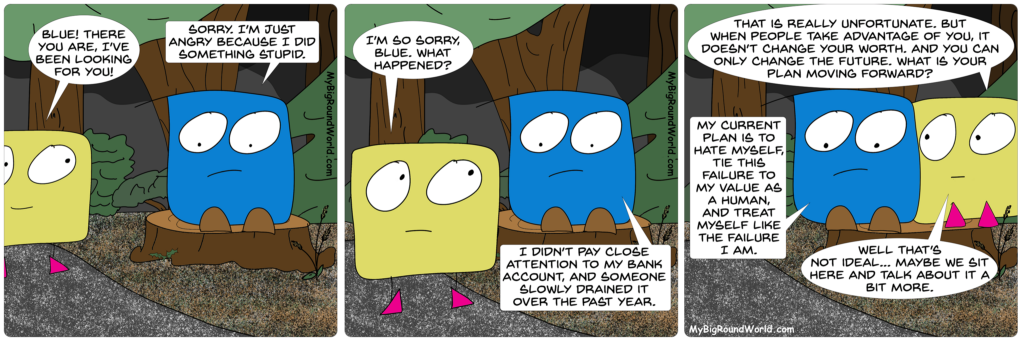
So yeah. It’s been a rough month. But it’s also been a good month. We really will be OK, and my intent is certainly not to make anyone worry about us. We didn’t fall for a scam, and yet we ended up losing the bulk of our “cushion” in arguably the worst time ever. My hope is that everyone looks a bit closer at their checking account after reading this, and if you do end up a victim of bank fraud — know that someone else’s evil is not a character flaw of yours. Be kind, maybe especially to yourself. It’s easy to be like Blue, and since I draw him, I know it first hand.

Success

Subscribe: Apple Podcasts | Google Podcasts | Spotify

Five years ago, my wife Donna and I invested our entire nest egg into buying an old farm in Brutus, MI. We refurbished the old barn, and created a young adult ministry, because there wasn’t one in the area. It turned out almost exactly like we pictured it, but then when it was still in its infancy, Emmet County shut us down. It was actually quite ugly, and they threatened to condemn the property if we even had a bible study in the farmhouse.

“The Barn” in its heyday…

So now, rather than the vibrant ministry we hoped to launch, Donna and I have a mountain of debt, a second property to pay taxes on, and a really nice barn we’re not allowed to use. It’s really easy to feel angry, foolish, and defeated.

But.

The young adults who were part of the fledgling ministry did not get shut down. They continued to meet in other locations. They kept meeting for worship music, bible studies, and fellowship. In fact, the core group of people still meet to this day, years after the actual barn was shut down. They still call their group “The Barn”, even though many of the current group members were not around when the actual barn was involved.

Over the past 5 years, 4 couples who met or got their start at the barn have gotten married. One of them is my eldest daughter, the singer in the video clip above. Her and her husband are expecting their first child, and our first grandchild, in September. The group of young adults that got started at our short-lived ministry continues to grow and flourish, even though my wife and I are no longer a part of it at all. Our barn sits empty, but I’m not sure I can consider it a failure.

Our goal when we started The Barn was to create a community of young adults who could grow together, and lean on each other as they transitioned to adulthood. We always intended for the group to take over once it was established. We wanted… exactly what happened. It just wasn’t exactly the way we expected it to happen.

Donna and I can always make more money. We can have a bit less extravagant retirement, which can start a few years later than we intended. Because when we decided to invest everything we had into the lives of the young adults we cared for, our intent was to change their lives, not create a business. And their lives are not only changed, but continue to change new lives who only know “The Barn” as a weird name that references some place they used to meet.

The Barn is both the biggest failure, and largest success we’ve had the pleasure to be involved in. It didn’t turn out like we planned, and yet it also ended up much better than we ever hoped.

Success, it seems, comes in many flavors.